
Takehiko Inoue is the Japanese manga artist behind Slam Dunk, Vagabond, and Real, three series that changed how sports and historical drama get told in comics. He is also, since 2022, an Academy Award-winning film director. Readers searching his name usually want to know one thing first: how did a former high school basketball player become one of the most respected storytellers in Japanese comics, and why does he take so long between chapters?
The short answer is that Inoue treats speed as the enemy of accuracy. He has built a four-decade career on research trips, live observation, and long pauses rather than a fixed release schedule, and that choice has shaped everything from Slam Dunk’s court sequences to his decision, at 55, to direct his first film.
A Childhood Split Between the Court and the Sketchbook
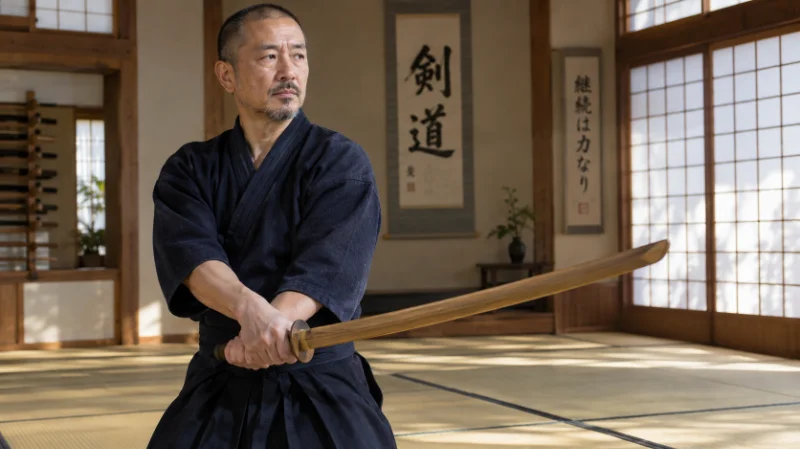
Inoue was born Takehiko Nariai on January 12, 1967, in Ōkuchi, a town in Kagoshima Prefecture that is now part of Isa, Kagoshima. He turned 59 in January 2026. From elementary school onward, he split his time between two disciplines that would define his later work: kendo and basketball. He eventually became captain of his junior high basketball team, and that hands-on experience- the footwork, the fatigue, the split-second decisions- later gave Slam Dunk its physical honesty.
He was drawing just as seriously. Shinji Mizushima’s baseball manga Dokaben and Akira Toriyama’s Dragon Ball were early influences, and by high school Inoue was already thinking about art school. He took a summer prep course aimed at an art university, but the cost was out of reach for his family, so he enrolled at Kumamoto University to study literature instead.
From a Kumamoto Dropout to Weekly Shonen Jump
College is where Inoue’s manga career actually started. He submitted a basketball-themed one-shot, Kaede Purple, to Shueisha’s Tezuka Award and made the finals of the 35th competition in 1988. That result got him an invitation to Tokyo to work as a professional mangaka, and he left Kumamoto University without finishing his degree.
Before he had his own hit, Inoue worked as an assistant to Tsukasa Hojo during the production of City Hunter, learning the pacing and paneling that Weekly Shonen Jump readers expected. His first tankobon series, Chameleon Jail, ran in the same magazine but never broke through. The lesson from those early years stuck with him: draw what he actually knew, starting with basketball.
Slam Dunk and the Manga That Changed a Sport
Slam Dunk began serialization in Weekly Shonen Jump in 1990 and ran until 1996. It follows Hanamichi Sakuragi, a delinquent who joins his high school basketball team to impress a girl and ends up genuinely falling for the sport. The manga eventually sold over 170 million copies worldwide, placing it among the best-selling manga series ever published.
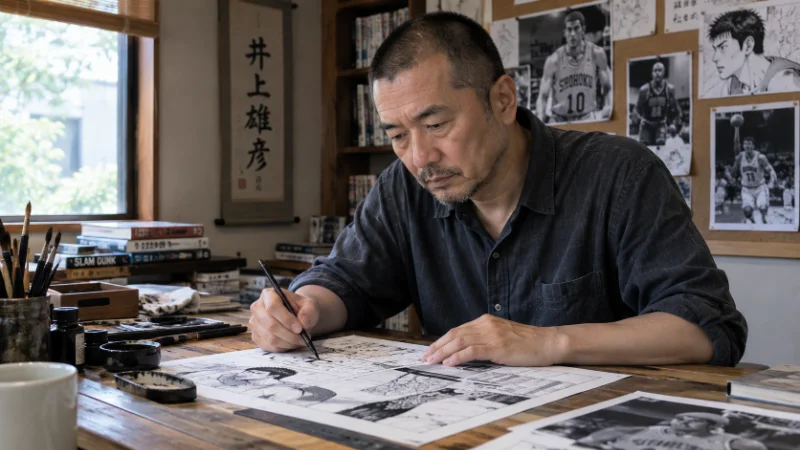
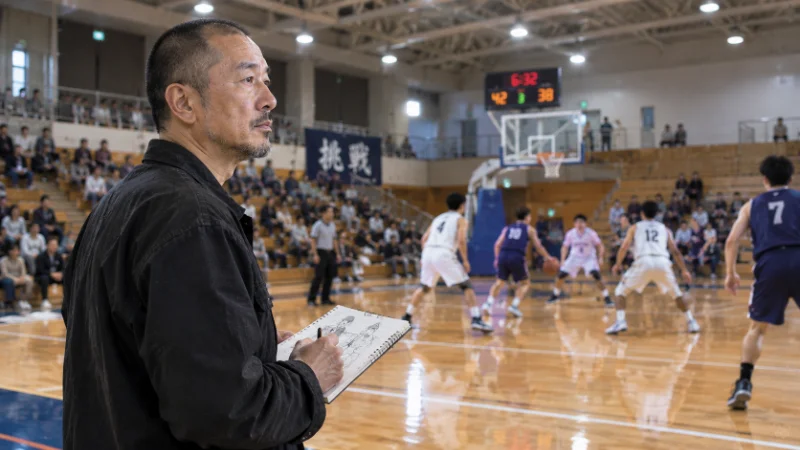
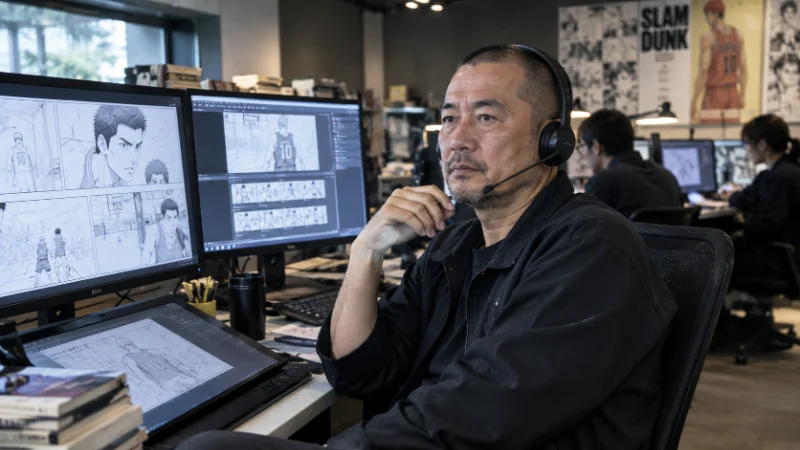
What made Slam Dunk different from other sports manga of its era was the research behind it. Inoue attended live games, studied hours of NBA footage, and drew players with real anatomical weight instead of the exaggerated proportions common in 1990s shonen art. The series is widely credited with driving a basketball boom across Japan and other parts of Asia, with schools reporting jumps in basketball club membership directly tied to its popularity. In 1995, it earned him the Shogakukan Manga Award.
Vagabond and the Weight of Perfection
After Slam Dunk ended, Inoue briefly experimented with online serialization through Buzzer Beater in 1996, then moved in a completely different direction. In 1998, he began Vagabond in Kodansha’s Weekly Morning, a fictionalized retelling of swordsman Miyamoto Musashi’s life based on Eiji Yoshikawa’s novel. To draw it, Inoue studied calligraphy and swordsmanship and traveled to historical sites connected to Musashi’s story.
Vagabond earned Inoue the Kodansha Manga Award in 2000 and is regularly named among the greatest manga ever drawn for its brushwork and its quiet, meditative pacing. It is also unfinished. The series stopped at chapter 327 in May 2015, and Inoue has said in interviews that the pressure of trying to make every page perfect turned the work from a passion into something closer to a burden. There is still no confirmed return date, though Inoue has spoken publicly about wanting to pick it back up.
He shifted his attention to Real, a series he had already started in 2000 in Shueisha’s Young Jump, centered on wheelchair basketball and three young men confronting disability, ambition, and identity. Real has had its own gaps, including a five-year pause between 2014 and 2019, but it remains the one manga Inoue continues to release on an irregular schedule today.
The First Slam Dunk: A Manga Legend Becomes a Director
In December 2022, Inoue stepped behind a camera for the first time. The First Slam Dunk was his directorial and screenwriting debut, told from the perspective of point guard Ryota Miyagi rather than protagonist Sakuragi, giving longtime readers a genuinely new angle on a story they already knew by heart.
The film became a box office phenomenon. It grossed roughly 279 million dollars worldwide, ranked among the highest-earning films in Japanese box office history, and set a record for the biggest opening weekend ever for an imported animated film in China at 55.2 million dollars. GKIDS brought it to North American theaters in July 2023 with both subtitled and English-dubbed versions.
At the 46th Japan Academy Film Prize in 2023, The First Slam Dunk won Animation of the Year, Inoue’s first nomination and win in film. It was also among the films eligible for Best Animated Feature at the 2024 Academy Awards, though the nomination that year went to Hayao Miyazaki’s The Boy and the Heron.
Recognition Beyond the Box Office
Inoue’s award history stretches well past his recent film success. He won the Tezuka Osamu Cultural Prize in 2002, became the first recipient of the Cultural Prize at the Asia Cosmopolitan Awards in 2012, and received the MEXT Arts Encouragement Prize in its Media Arts division in 2024. Fellow mangaka, including One Piece creator Eiichiro Oda, have publicly described him as a defining influence on the current generation of Japanese comic artists.
Life Beyond the Page
Inoue is also a trained watercolorist who has held multiple solo exhibitions of his fine art, most recently a 2025 Tokyo show that included previously unseen Vagabond sketches. After the Great East Japan Earthquake in March 2011, he produced a series of more than 50 hand-brushed illustrations called Smile, posting each one online as a message of encouragement to affected communities rather than selling them commercially.
His basketball connections have carried into real sport as well. Inoue was commissioned by the Japan Basketball Association to design the national team’s uniforms for the Tokyo 2020 Olympics, tying together the two obsessions, drawing and basketball, that shaped him as a teenager in Kagoshima.
Inoue has kept his personal life largely out of the press, and there is no publicly disclosed figure for his net worth. What is verifiable is the commercial scale of his work: manga sales in the hundreds of millions of copies, a film that grossed close to 280 million dollars, and decades of magazine serialization across two of Japan’s biggest publishers, Shueisha and Kodansha.
Why Takehiko Inoue Still Matters
Most prolific mangaka are defined by output. Inoue is defined by the opposite instinct, a willingness to stop entirely rather than publish something he does not believe in. That decision cost Vagabond a decade and counting, but it is also what makes Slam Dunk’s court scenes and Vagabond’s sword fights feel observed rather than invented.
The First Slam Dunk proved that instinct translates to film as well as manga. Three decades after he first put Sakuragi on a page, Inoue used a new medium to tell the same story from an angle nobody expected, and audiences in Japan, China, South Korea, and North America responded the way they did the first time around. For a reader discovering him today, that pattern- patience over speed, research over shortcuts- is the clearest thread running through his entire career.